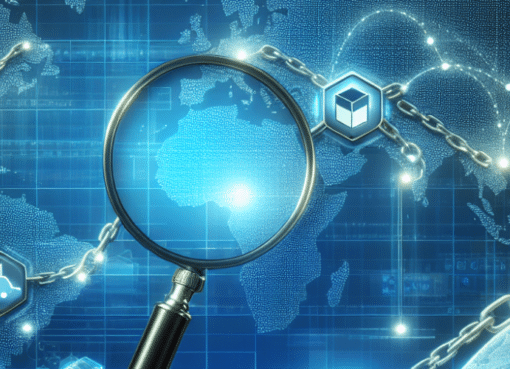

In a groundbreaking development, some of the world’s largest logistics and supply chain management companies are turning to blockchain technology to revolutionize how goods are tracked from manufacturer to consumer. This shift comes in the wake of recent global disruptions that have underscored the critical importance of transparency and efficiency in the logistics sector.
The recent pandemic, geopolitical tensions, and natural disasters have exposed significant vulnerabilities in global supply chains. Delays, lost shipments, and fraud have been costly, prompting industry leaders to seek more resilient and reliable methods to keep track of goods. Blockchain technology, known for its robust security features and decentralization, has emerged as a key solution to these challenges.
Blockchain operates as a distributed ledger system, where each transaction or movement of goods is recorded and verified across multiple nodes, or computers, making it nearly impossible to tamper with. This transparency ensures that every party involved in the supply chain — from manufacturers to end consumers — can track the journey of a product in real-time.
Leading the charge in this blockchain revolution is ChainLogix, a multinational logistics company that recently launched a pilot program integrating blockchain technology into their operations. “Our goal is to implement a more transparent, efficient, and secure system, ensuring that all stakeholders have access to accurate information and thus can make better-informed decisions,” remarked Sarah Tan, Chief Technology Officer at ChainLogix.
The pilot program builds on recent successful implementations of blockchain in other sectors such as finance and healthcare. “What differentiates our approach is the focus on creating an interoperable network that can seamlessly integrate with existing systems used by our partners and clients,” Tan explained. This is particularly significant because one of the biggest hurdles in adopting new technologies in logistics has been the fragmentation of different systems used across the sector.
The benefits of integrating blockchain into supply chain operations are manifold. For instance, the ability to track the provenance and authenticity of goods can significantly reduce fraud, a major issue in industries such as pharmaceuticals and luxury goods. Additionally, the increased efficiency can lead to lower operational costs, faster delivery times, and reduced environmental impact.
Feedback from initial users of the ChainLogix system has been overwhelmingly positive. “The level of detail and accuracy we can now access is unprecedented. It’s like moving from regular television to high-definition,” said one user, who preferred to remain anonymous due to corporate policy.
Yet, adopting blockchain isn’t without its challenges. The technology demands significant computational power and can be complex to integrate with traditional systems. Moreover, for the full benefits of blockchain to be realized, widespread adoption across the supply chain is necessary — a process that could take years.
Despite these hurdles, the industry’s response has been enthusiastic. A recent survey conducted by Logistics Management Institute found that over 70% of supply chain managers are either currently exploring or have plans to explore blockchain technology within the next five years.
The broader implications of this shift could be substantial, potentially setting new standards for how global trade is conducted. Governments and international trade bodies have also shown interest, recognizing the potential of blockchain to enhance not only economic efficiency but also security and compliance with regulations.
As this technology continues to evolve, the future of logistics and supply chain management looks poised for significant transformation. For consumers, this could mean more reliable delivery times, better products, and an overall increase in trust in the goods they purchase. For businesses, it represents an opportunity to streamline operations, reduce costs, and build stronger relationships with consumers.
In an era where technology is rapidly changing the face of every industry, blockchain appears set to be the next big disruptor in logistics. As more companies like ChainLogix pioneer its integration, the entire supply chain might soon be the model for a new era of global commerce built on transparency, efficiency, and trust.